

 English
 Español
 हिंदी
हिंदी Tiếng Việt
Industry News

How Can Custom Filter Press Plates Optimize Your Filtration System?
 2026.08.31
 Industry News
Content
- 1 Why Choose Custom Filter Press Plates Instead of Standard Plates?
- 2 Start with a Detailed Process Analysis
- 3 Optimize Plate Material for Your Working Environment
- 4 Customize Chamber Depth for Maximum Productivity
- 5 Improve Drainage Channel Design
- 6 Select the Right Plate Size
- 7 Enhance Filter Cake Dryness
- 8 Increase Filtration Speed
- 9 Improve Sealing Performance
- 10 Adapt Plates for High-Pressure Applications
- 11 Improve Compatibility with Automation Systems
- 12 Reduce Maintenance Requirements
- 13 Support Industry-Specific Applications
- 14 Lower Total Cost of Ownership
- 15 Work with an Experienced Filter Press Plate Manufacturer
- 16 FAQ
In today’s competitive industrial environment, achieving maximum filtration efficiency requires more than simply selecting a high-quality filter press. The design and configuration of Custom Filter Press Plates play a decisive role in determining filtration capacity, cake dryness, cycle time, operating costs, and long-term equipment reliability.
Standard filter press plates are suitable for many general applications, but they may not provide the best performance for operations with unique slurry characteristics, specialized production requirements, or challenging working conditions. Every filtration process is different—whether it involves mining tailings, chemical slurries, municipal sludge, food-grade products, or pharmaceutical materials. As a result, an increasing number of manufacturers are investing in customized filter press plate solutions tailored to their specific processes.
Why Choose Custom Filter Press Plates Instead of Standard Plates?
Standard Filter Press Plates are designed to meet general industrial requirements. While they offer reliable performance in many situations, they cannot always accommodate the unique demands of different industries.
Custom Filter Press Plates are engineered according to specific process parameters, including slurry composition, filtration pressure, cake thickness, operating temperature, chemical compatibility, and production capacity.
Compared with standard products, customized plates offer several advantages:
- Higher filtration efficiency
- Faster filtration cycles
- Better filter cake dryness
- Improved filtrate clarity
- Longer equipment lifespan
- Lower maintenance requirements
- Reduced operating costs
- Greater process stability
By matching the plate design to the filtration process, businesses can achieve measurable improvements in both productivity and product quality.
Start with a Detailed Process Analysis
The first step in designing Custom Filter Press Plates is understanding the filtration process.
Manufacturers typically evaluate:
- Slurry composition
- Solid concentration
- Particle size distribution
- Particle hardness
- Slurry viscosity
- pH value
- Operating temperature
- Corrosiveness
- Abrasiveness
- Daily processing capacity
- Moisture requirements
- Installation conditions
Accurate process data enables engineers to optimize the plate structure for maximum performance.
For example, highly abrasive mineral slurries require reinforced plate designs, while pharmaceutical applications prioritize contamination control and hygienic construction.
Optimize Plate Material for Your Working Environment
Material selection has a significant impact on filtration performance and equipment durability.
Custom Filter Press Plates can be manufactured using different materials based on operating conditions.
|
Plate Material |
Advantages |
Recommended Applications |
|
Polypropylene (PP) |
Lightweight, chemical resistant, cost-effective |
Wastewater, food, chemicals |
|
Reinforced Polypropylene |
High mechanical strength |
Mining, metallurgy |
|
PVDF |
Excellent corrosion resistance |
Strong acids, specialty chemicals |
|
Stainless Steel |
Hygienic and high-temperature resistant |
Food and pharmaceutical |
|
Cast Iron |
Superior heat resistance |
High-temperature industrial filtration |
Selecting the proper material ensures long service life while reducing maintenance costs.
Customize Chamber Depth for Maximum Productivity
One of the biggest advantages of custom filter plates is the ability to optimize chamber depth.
Different chamber depths produce different filtration results.
Shallow chambers generally provide:
- Faster filtration cycles
- Quicker cake discharge
- Higher daily throughput
Deeper chambers provide:
- Larger cake volume
- Greater solid handling capacity
- Fewer filtration cycles
The optimal chamber depth depends on production goals rather than simply maximizing capacity.
Improve Drainage Channel Design
Drainage channel geometry directly affects filtrate flow.
Modern customized Filter Press Plates often incorporate:
- Optimized drainage paths
- Uniform liquid distribution
- Reduced hydraulic resistance
- Improved filtrate collection
- Faster liquid removal
Better drainage design shortens filtration cycles while maintaining excellent filtrate clarity.
Computer-aided engineering allows manufacturers to optimize channel patterns for specific slurry properties.
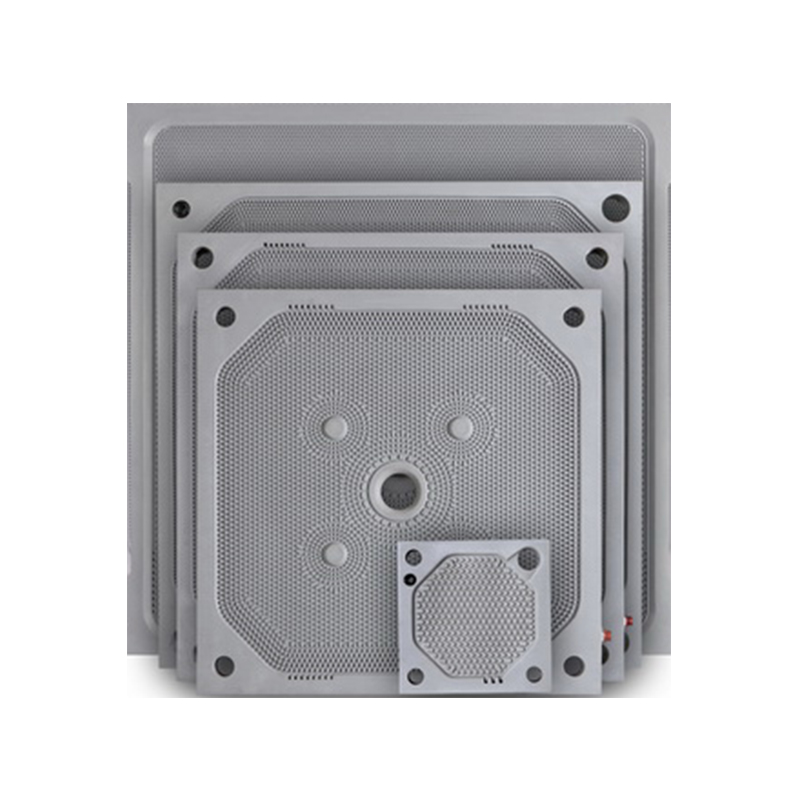
Select the Right Plate Size
Plate dimensions influence filtration area and production capacity.
Common plate sizes include:
|
Plate Size |
Typical Applications |
|
500 × 500 mm |
Small production |
|
630 × 630 mm |
Medium capacity |
|
800 × 800 mm |
Industrial filtration |
|
1000 × 1000 mm |
Large production |
|
1250 × 1250 mm |
Heavy-duty processing |
|
1500 × 1500 mm |
Mining and metallurgy |
|
2000 × 2000 mm |
Large-scale industrial systems |
Custom sizing helps maximize available installation space while meeting production targets.
Enhance Filter Cake Dryness
Many industries aim to reduce the moisture content of the filter cake because drier cakes are easier and less expensive to transport, dispose of, or reuse.
Customized Filter Press Plates can improve cake dryness through:
- Optimized chamber geometry
- Uniform pressure distribution
- Improved drainage channels
- Better sealing performance
- Enhanced cake compression
Lower moisture content often results in lower disposal costs and improved downstream processing efficiency.
Increase Filtration Speed
Filtration speed is influenced by several plate-related factors.
Custom engineering can optimize:
- Chamber structure
- Liquid flow paths
- Plate rigidity
- Feed distribution
- Pressure balance
These improvements reduce filtration resistance and shorten cycle times.
Higher productivity allows manufacturers to process more slurry without increasing equipment size.
Improve Sealing Performance
Leakage is one of the most common causes of filtration inefficiency.
Custom Filter Press Plates can incorporate:
- Precision-machined sealing surfaces
- Enhanced gasket grooves
- Improved plate alignment
- Reinforced sealing structures
Better sealing reduces filtrate leakage while maintaining stable operating pressure.
This also improves workplace cleanliness and environmental compliance.
Adapt Plates for High-Pressure Applications
Some industries require filtration pressures exceeding those of standard operating conditions.
Customized plates may include:
- Reinforced internal structures
- Increased mechanical strength
- Higher pressure ratings
- Improved deformation resistance
High-pressure capability is particularly valuable in mining, metallurgy, ceramics, and chemical processing.
Improve Compatibility with Automation Systems
Modern filtration plants increasingly utilize automated production.
Custom Filter Press Plates can be designed to work seamlessly with:
- Automatic plate shifters
- Automatic cake discharge systems
- Cloth washing devices
- PLC controls
- Hydraulic automation
- Remote monitoring systems
Automation minimizes manual labor while increasing production consistency.
Reduce Maintenance Requirements
Customized engineering can significantly lower maintenance costs.
Features that improve maintenance efficiency include:
- Wear-resistant surfaces
- Easy cloth replacement
- Durable sealing areas
- High-strength construction
- Simplified cleaning design
Lower maintenance requirements increase equipment availability and reduce production interruptions.
Support Industry-Specific Applications
Different industries benefit from customized Filter Press Plates in different ways.
|
Industry |
Customization Benefits |
|
Mining |
Wear resistance, high pressure, large capacity |
|
Wastewater Treatment |
Fast cake release, low maintenance |
|
Chemical Processing |
Corrosion resistance, leak prevention |
|
Food & Beverage |
Hygienic design, easy cleaning |
|
Pharmaceuticals |
High purity, contamination control |
|
Ceramics |
Uniform pressure distribution |
|
Metallurgy |
High-temperature durability |
|
Paper & Pulp |
Efficient dewatering, improved throughput |
Industry-specific customization ensures the filtration system performs at its highest efficiency under actual operating conditions.
Lower Total Cost of Ownership
Although Custom Filter Press Plates may require a higher initial investment than standard products, they often reduce lifetime operating costs.
Key savings include:
- Shorter filtration cycles
- Lower energy consumption
- Reduced labor requirements
- Fewer replacement parts
- Longer service life
- Reduced downtime
- Lower maintenance expenses
- Improved product recovery
These long-term savings often outweigh the initial customization cost.
Work with an Experienced Filter Press Plate Manufacturer
Successful customization depends on the manufacturer’s engineering expertise and production capabilities. A reliable supplier should be able to analyze process data, recommend appropriate materials, optimize plate structures, and provide customized solutions that match your filtration objectives.
Jiangsu Sudong Chemical Machinery Co., Ltd. specializes in designing and manufacturing Custom Filter Press Plates for industries such as mining, wastewater treatment, chemical processing, metallurgy, food and beverage, pharmaceuticals, ceramics, and environmental protection. By combining advanced molding technology, high-quality materials, and tailored engineering solutions, the company helps customers improve filtration efficiency, shorten cycle times, reduce maintenance costs, and extend equipment service life.
FAQ
Q1: What are Custom Filter Press Plates?
A: Custom Filter Press Plates are specially designed filtration plates engineered to meet specific process requirements, such as slurry characteristics, operating pressure, chamber depth, material compatibility, and production capacity, providing better performance than standard plates.
Q2: Are custom filter press plates suitable for all industries?
A: Yes. Custom Filter Press Plates can be tailored for mining, wastewater treatment, chemical processing, food and beverage, pharmaceuticals, ceramics, metallurgy, paper production, and many other industries with unique filtration requirements.
Q3: Can customized plates improve filtration efficiency?
A: Absolutely. Optimized chamber geometry, drainage channels, material selection, and sealing design can reduce filtration resistance, shorten cycle times, improve filtrate clarity, and produce drier filter cakes.
Q4: Do custom filter press plates require special maintenance?
A: No. They are maintained in much the same way as standard plates, including routine cleaning, inspection for wear or damage, seal checks, and timely replacement of filter cloths. Many custom designs actually simplify maintenance and extend service life.
Q5: Is investing in Custom Filter Press Plates cost-effective?
A: In most cases, yes. Although the initial purchase cost may be higher, customized plates often deliver lower lifetime operating costs through improved productivity, reduced downtime, lower maintenance expenses, longer service life, and higher overall filtration efficiency.
Contact Information
 No. 1, Sudong Road, Guxi Town, Taixing, Jiangsu, China
 +86-15720778188
 +86-523-87791016
 +86-523-87797781
 [email protected]

;void(0))