

 English
 Español
 हिंदी
हिंदी Tiếng Việt
Industry News
 Home / News / Industry News / Why do your filter press filter cloths frequently get clogged or damaged?
 Why do your filter press filter cloths frequently get clogged or damaged?
 2026.02.23
 Industry News
Content
- 1 1. Chemical and Thermal Compatibility: Material Selection is the Foundation
- 2 2. Weave Type and Particle Matching: Solving the Logic of “Blinding”
- 3 3. Feed Pressure Management: More Pressure Does Not Mean Better Results
- 4 4. Cake Release and Routine Cleaning: The Art of Maintenance
- 5 5. Mechanical Factors: Check Your “Hardware” Health
1. Chemical and Thermal Compatibility: Material Selection is the Foundation
Among the various reasons for frequent filter cloth failure, chemical erosion and thermal degradation are often the most insidious. Many companies prioritize filtration precision during procurement but overlook the complex chemical nature of the slurry. The polymer fibers used in filter cloths—such as Polypropylene (PP), Polyester (PET), and Polyamide (Nylon)—react very differently to pH levels.
For instance, if you utilize a Polyester cloth when treating highly alkaline industrial wastewater, the fibers will undergo rapid hydrolysis. This causes the cloth to become brittle and lose its tensile strength significantly, potentially shattering under the mechanical pressure of the plate closure. Conversely, while Nylon boasts excellent abrasion resistance, it degrades quickly in acidic solutions.
Beyond chemical compatibility, operating temperature is a critical factor. When a Filter Press Cloth operates above its thermal stability limit, the fibers undergo molecular restructuring. This leads to dimensional shrinkage—causing the cloth to misalign with the plate’s drainage ports—and loss of elasticity. To prevent these costly failures, it is essential to conduct precise pH testing and record maximum operating temperatures before selecting a material.
2. Weave Type and Particle Matching: Solving the Logic of “Blinding”
If your feed pressure is normal but your filtration cycles are becoming increasingly long, your cloth is likely suffering from mechanical blinding. This phenomenon usually stems from a mismatch between the cloth’s “weave” and the particle size distribution of the slurry.
Filter cloths are generally categorized into Monofilament and Multifilament. Multifilament cloths are woven from strands of tiny twisted fibers; while they are excellent at capturing fine particles and offer high tensile strength, their internal gaps tend to “trap” fine solids. Once these particles are embedded deep within the fiber bundles, standard cleaning processes struggle to remove them.
In contrast, Monofilament cloths consist of single, smooth synthetic strands. They offer superior cake release properties because particles cannot easily adhere to the smooth surface. For viscous or “sticky” materials, using a monofilament cloth with a calendered (heat-pressed) finish can drastically improve performance. Furthermore, selecting the correct pore size should follow the “Bridging Theory”—the pore should be slightly larger than the average particle diameter to allow a “bridge” of solids to form the actual filter media, rather than relying on the cloth alone to block every particle.
3. Feed Pressure Management: More Pressure Does Not Mean Better Results
On the production floor, operators often assume that increasing the feed pump pressure will accelerate the filtration process. However, from the perspective of fluid mechanics and fiber stress, this is often counterproductive. When pressure exceeds the design limits (typically above 0.6–1.0 MPa), several negative outcomes occur:
Excessive pressure forces fine particles into the deep layers of the fabric. This deep-seated blinding is irreversible and leads to a catastrophic drop in the cloth’s permeability. Second, the sealing area around the edges of the filter plate is subjected to immense shear force. High pressure can cause the cloth to be pinched, distorted, or even torn at the gasket line, resulting in slurry leakage or “blowouts.”
Initial feed pressure control is particularly vital. We recommend using Variable Frequency Drives (VFDs) to achieve constant flow feeding. During the early stages of a cycle, before the filter cake has formed, low-pressure feeding allows a uniform “pre-coat” layer to build up. This layer actually protects the cloth; a high-pressure surge at the start slams particles directly into the micro-pores, sealing them instantly.
4. Cake Release and Routine Cleaning: The Art of Maintenance
Filter cloth damage often begins with “incomplete discharge.” When the filter cake remains stuck to the cloth due to high viscosity or surface roughness, those residual solids are further compressed during the next filtration cycle.
As cycles continue, these residues form a hardened “scale” or “heel,” rendering sections of the cloth impermeable. This does more than just reduce output; it creates uneven pressure distribution across the filter plate. Under the massive clamping force of the press, this imbalance can cause plates to warp or the cloth to snap along the stressed edges.
Therefore, a scientific cleaning protocol is the core of extending cloth life. We recommend periodic high-pressure water washing, though the pressure and angle must be carefully calibrated to avoid fraying the fibers. Additionally, depending on the material being processed, chemical cleaning (acid or alkaline wash) should be employed. For example, in mining tailings where calcium salts cause the cloth to stiffen, a periodic weak acid wash can restore the cloth’s original softness and porosity.
5. Mechanical Factors: Check Your “Hardware” Health
Sometimes, the filter cloth is merely the “scapegoat” for a mechanical failure in the press itself. As a consumable, the cloth is the most vulnerable part of the system, and any mechanical misalignment will manifest as cloth damage.
- Plate Misalignment:If the plates are not perfectly aligned when closed, the cloth will be subjected to uneven compression, leading to permanent creasing or edge tearing.
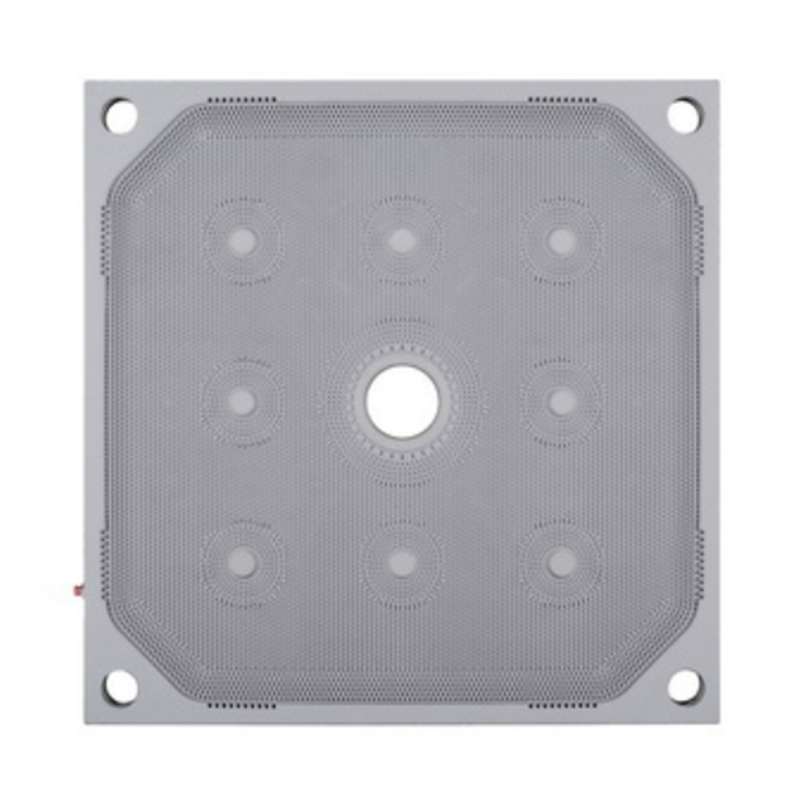
- Plate Surface Condition:Inspect the drainage “pips” or grooves on the plate surface. If these are worn sharp or clogged with debris, the cloth will act like it is being rubbed against sandpaper during the high-pressure squeeze, leading to rapid abrasive wear on the backside.
- Hanging and Tension:If the cloth is not hung correctly or if the weight-rods are skewed, it may shift during the feed stroke. This causes the feed holes to misalign, leading to massive pressure on the cloth stays and eventual blowout.
Regularly inspecting the flatness of the plates and the condition of the sealing surfaces is a prerequisite for ensuring your filter cloth reaches its full service life.
Contact Information
 No. 1, Sudong Road, Guxi Town, Taixing, Jiangsu, China
 +86-15720778188
 +86-523-87791016
 +86-523-87797781
 [email protected]

;void(0))